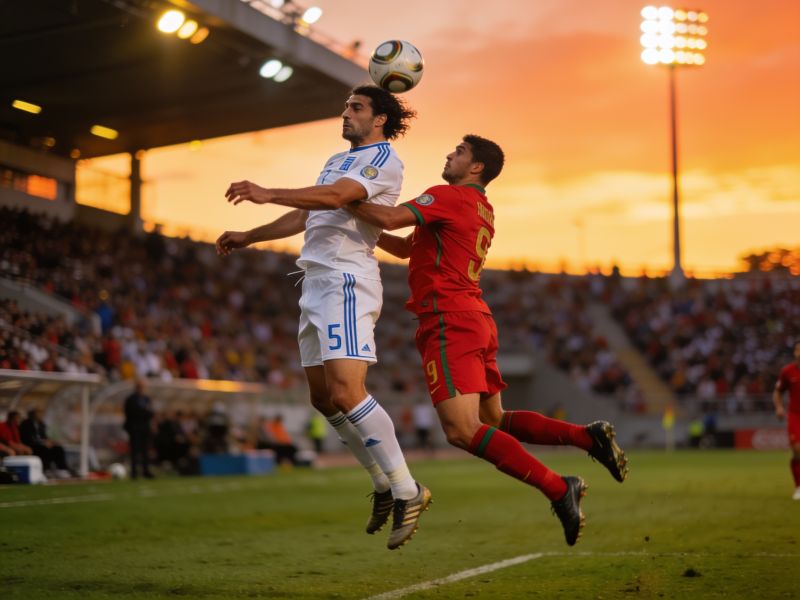
Greece won Euro 2004. Not a typo. A team that had never won a knockout match at a major tournament before went all the way in Portugal, and they did it by beating the hosts twice. If you want to understand how that happened—or just want to relive it properly—start with the final in Lisbon. Greece 1-0 Portugal. Angelos Charisteas scored the only goal in the 57th minute, a header from a corner. Portugal had Luis Figo。Deco, Cristiano Ronaldo (then a 19-year-old with bleached tips). Greece had Theodoros Zagorakis, who was named player of the tournament. That mismatch alone tells you everything about Euro 2004: it was a masterclass in collective discipline over individual flair.Otto Rehhagel, the German coach, built a defensive structure that opponents called boring. I call it ruthless. Greece conceded just four goals in six matches, and two of those came in a wild 4-2 group-stage loss to Spain?No—actually they drew 1-1 with Spain and lost 2-1 to Russia in the group. Wait, let’s get the facts straight. Greece’s group: they beat Portugal 2-1 in the opener, drew 1-1 with Spain, lost 2-1 to Russia. Then in the knockout rounds: 1-0 vs France。1-0 vs Czech Republic (silver goal in extra time), 1-0 vs Portugal in the final. Three consecutive 1-0 wins. That’s not luck. That’s a system. Rehhagel used a flexible back four with man-marking, and midfielder Zagorakis covered every blade of grass. You can watch those matches on UEFA’s official YouTube channel—the full final is there, free. Do it with the sound on. The Portuguese crowd’s silence at the end is haunting.If you’re coaching a youth team or just want to study Euro 2004 tactically, ignore the possession stats. Greece averaged around 40% possession in most games. Focus on their set-piece defending—zonal marking with one player on the near post—and their counterattacks. Charisteas wasn’t fast。but he held the ball up, and wide players like Giannakopoulos and Katsouranis broke forward in bursts. The Czech Republic game is the best example: Greece absorbed pressure for 105 minutes, then scored from a corner in the silver-goal period. Petr Čech, then at his peak, couldn’t stop it. That match also featured a horrific injury to Czech midfielder Pavel Nedvěd, who limped off after a collision. Euro 2004 had moments of real brutality, and Greece thrived in the chaos.What can you actually do with this knowledge today?
Three practical things. First。use the Euro 2004 final as a case study in underdog psychology. Watch how Greece’s players celebrated every clearance like a goal. Second, if you play fantasy football or bet on tournaments, remember that defensive teams with a clear identity often outperform flashier squads in knockout formats—Euro 2004 is the ultimate proof. Third, visit the Greek football museum in Athens if you’re ever there;they have Charisteas’s boots and Rehhagel’s tactical notes on display. It’s a small exhibit, but it brings the tournament back to life. I spent an hour there last summer and left convinced that Euro 2004 wasn’t a fluke. It was a blueprint.One more thing: don’t let anyone tell you Greece “parked the bus” They pressed selectively, especially in the semi-final against the Czechs. Rehhagel drilled them to win the second ball after every long clearance. That’s why they beat France—Zidane had no space to turn. So next time you rewatch Euro 2004, pause on the off-ball movement. You’ll see a team that knew exactly what it was doing. And you’ll never call it boring again.